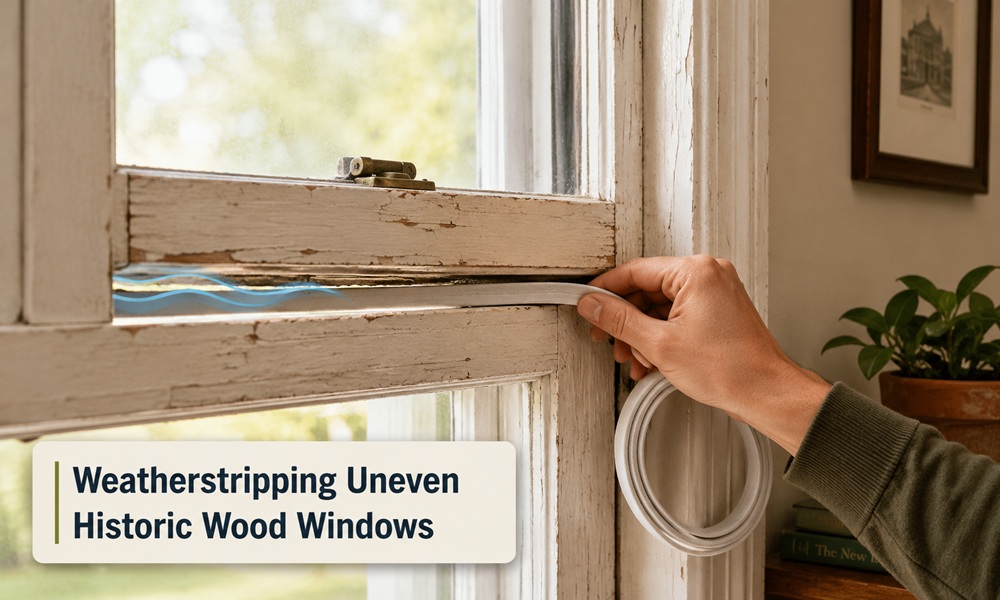
A drafty historic window is one of the most fixable problems in an old house — and one of the most over-prescribed for replacement. Salespeople will tell you the only answer is a new vinyl unit, but a century-old double-hung that whistles in the wind almost always just needs the right weatherstripping matched to its particular gaps. Done well, the repair seals the draft, preserves the irreplaceable original window, and often makes the sash glide more smoothly than it has in decades. The secret is that there is no single best weatherstrip — there is a best one for each gap size and each part of the window. This guide shows how to choose and where to put it.
Why old windows go gappy — and why that’s fixable
Historic windows were built to move — to expand, contract, and breathe with the seasons. Add a century of settling, paint buildup, and seasonal shrinkage and you get uneven gaps: a sash that’s tight on one side and loose on the other, “slop” front-to-back, and whistling drafts at the meeting rail. The good news: you almost never need to replace these windows. Quality weatherstripping restores a tight seal, keeps the historic character, and often makes the sash operate more smoothly than before. Unlike a sealed replacement unit, a repaired historic window can be serviced indefinitely — there are no failed gas seals or obsolete parts to chase.
Match the material to the gap
This is the part most guides get wrong — bigger isn’t better. Each profile has a gap range it seals well; outside that range it underperforms or wears out fast.
| Weatherstrip | Gap range it seals | Best for | Notes |
| Flat spring bronze (Pro-Type) | ~1/16” to 1/4” | Tight, fairly uniform double-hung channels | Beautiful patina, lasts 100+ yrs; nailed every ~1.5–2” — tedious but durable |
| V-bronze (cushion type) | ~1/8” to 1/2” | Larger, uneven gaps from sashes that settled | Double-contact V-fold; the go-to for irregular historic gaps and doors |
| Silicone bulb | Compressible, sized to gap | Sill and head where sash closes | Best when slightly recessed so the bulb only partly compresses; comes in colors |
| Brush / wool pile | Tight, sliding gaps | Smoother sash movement in narrow channels | Low friction but flattens if over-compressed |
| Lock strip (e.g., 27B) | Front-to-back “slop” | Sashes loose front-to-back at the blind stop | Resolves slop that side-to-side strips can’t |
Sizing insight worth flagging: spring bronze can be “sprung” to bridge slightly bigger gaps, but it doesn’t perform well past about 1/4” — which is exactly the situation on settled historic windows. That’s why V-bronze is usually the better default for uneven old sashes: its double-contact V fills 1/8” to 1/2”. And silicone bulb should be recessed so it’s only partly compressed at full close; over-compressing it wears it out prematurely.
Where each piece goes on a double-hung
A double-hung needs sealing in several places, and the right material depends on how each part moves:
- Side jambs (sliding contact): spring bronze or V-bronze on the jamb, against each sash. (For side-to-side slop, the bronze handles it.)
- Meeting rail (where the two sashes overlap): spring bronze or a felt/brass meeting-rail strip — a major draft zone.
- Head (top of upper sash) and sill (bottom of lower sash): silicone bulb or bronze where the sash closes into the frame.
- Front-to-back slop: a lock strip on the back of the blind stop closes the gap that jamb strips can’t.
On narrow double-hung jambs, use the 5/8” width so the strip doesn’t interfere with the sash-weight pulley and cord — it can often be installed without removing the sash. Use the wider 1-1/8” on doors and the meeting rail.
Installation tips that save grief
- Restore the window first — free up stuck sashes, reglaze as needed, and replace broken hardware before weatherstripping.
- On the jambs, cut around pulleys, latches, and hardware; run the strip slightly past the sash travel so it doesn’t “catch.”
- Fasten with copper-plated or solid bronze nails (bronze in coastal/marine air) roughly every 1.5–2 inches for spring bronze.
- Test operation as you go — metal weatherstrip that’s too tight can make the sash hard to move; tweak the spring slightly for a snug-but-smooth fit.
- For the biggest performance jump, pair weatherstripping with a custom storm window — the combination can cut air infiltration by over 70% without removing a single original sash.
A restraint many overlook: some historic double-hungs were designed to operate without weatherstripping, and over-adding spring bronze to every surface can make them hard to close and even interfere with a tight shut. If other windows in the house have original weatherstrip in good shape, match it; if they never had any, weatherstrip only the surfaces that actually leak.
Tools and materials checklist
A typical double-hung weatherstrip job is low on tools but rewards patience. Have ready:
- Spring bronze and/or V-bronze in the right widths, plus silicone bulb for the sill and head.
- Solid-bronze or copper-plated nails, a small tack hammer, and a nail set.
- Tin snips for cutting bronze, a putty knife, and a scraper for paint buildup in the channels.
- A pry bar and glazing supplies if you are restoring the sash first.
Frequently asked questions
| What weatherstripping is best for uneven, gappy old windows?
V-bronze (cushion type). Its double-contact V profile seals the irregular 1/8”–1/2” gaps typical of settled sashes, where flat spring bronze (good only to ~1/4”) falls short. How long does metal weatherstripping last? Spring bronze and V-bronze can last 100+ years — there are documented installations over a century old still working. That’s why it’s far more cost-effective over time than foam or vinyl, which fail in a year or two. Does weatherstripping ruin a historic window’s value? No. The National Park Service’s Preservation Brief #9 recommends weatherstripping as part of historic window repair, and it’s reversible and nearly invisible when installed well. Can I weatherstrip without removing the sash? Often yes — the narrow 5/8” jamb bronze can be installed with the sash in place, and bulb/strip products at the head and sill go on without disassembly. Full restoration jobs remove the sash for access. Is bronze worth it over cheap foam tape? Over time, yes. Self-adhesive foam is cheap and easy but typically fails within a year or two, especially on sliding surfaces. Bronze costs more upfront and takes longer to install, but it seals better and can outlast the rest of the window. |